
Salutations and Valedictions!
I have taken this opportunity to write these few lines hoping they find you in good health

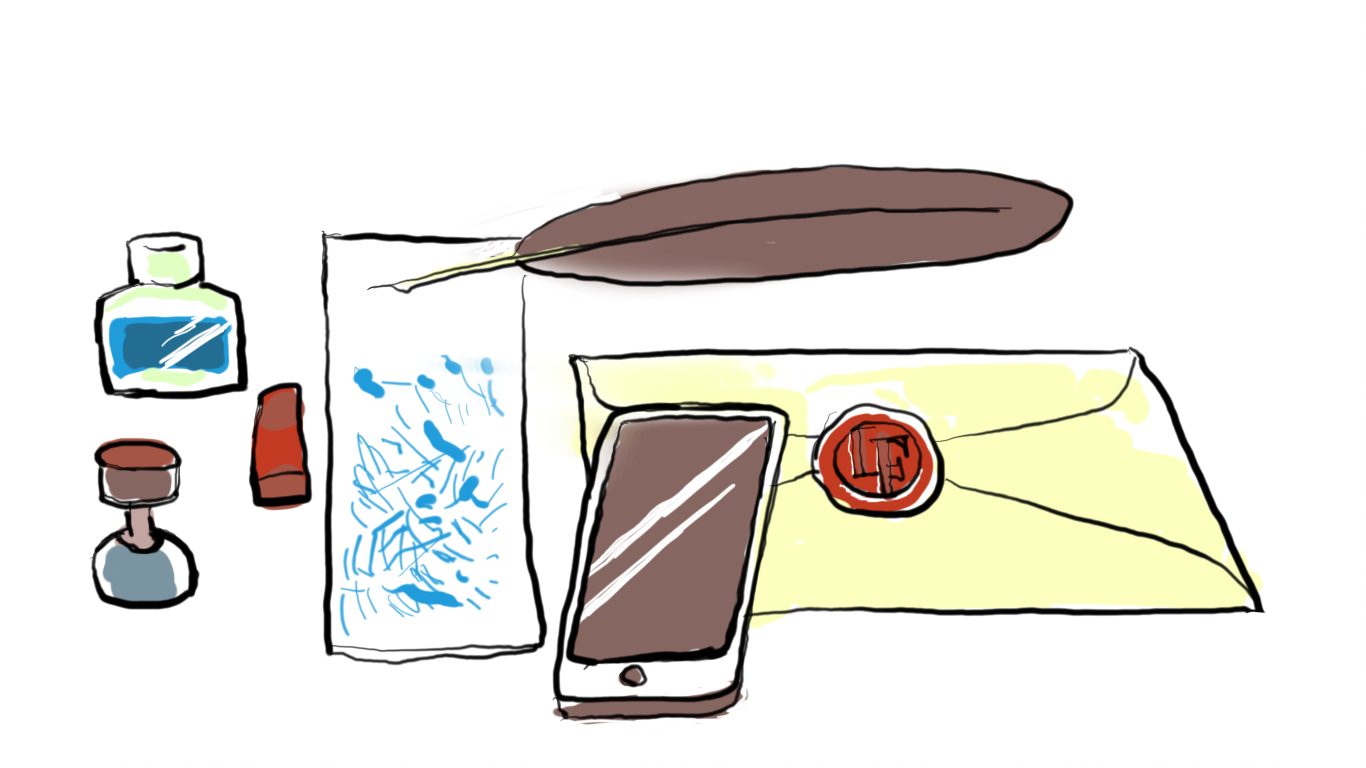
Once you've made your quill pen, you might find yourself thinking about writing letters. It's a nice thing to think about, but what you probably write more often are emails.1 Emails are different from letters: you don't open with My dearest so-and-so, and you don't close with Your most obedient and humble servant.
The greeting at the start is called the salutation, and the ending is called the valediction,2 or more commonly the complimentary close.
Salutations and complimentary closes used to follow a relatively strict formula:3
An intimation of the intention to write.
A wish, originally a prayer, for the recipients’ health.
A statement of the writer’s health at the time of writing.
“Thanks be to God for it” or an equivalent phrase.
In practice, that formula leads to an opening like this:
I have taken this opportunity to write these few lines hoping they find you in good health as it leaves me at present thanks be to God for it.4
This is, as you have noticed, the ancestor of I hope this email finds you well.5
These days, we don't even use the salutation Dear, which was apparently first used to start a letter in 1450 by Queen Margaret of Anjou, wife of King Henry VI.6 Since the 17th century, Dear so-and-so has been the normal salutation in letter-writing,7 until email came along.
While Dear is appropriate for formal emails, most people use Hi so-and-so for someone with whom they have an irl8 relationship. Where a business letter might once have said Dear Messrs. and Mmes. of the board, the equivalent email can start with Hi everyone, or even a terse All. Only spam email seems to preserve the overly ornamented language of formal letter-writing9, possibly because genre pressure and the lack of a uniform, worldwide prestigious form10 lead the spammers into baroquely aimless formalities.
Maybe the economy of email salutations and valedictions, and the I hope this email finds you well meme, are indications that no one likes to read email. Perhaps people would enjoy reading email more if we brought back the old ways.
I am, my dearest friend, most affectionately and kindly yours,
Lingua Frankly.
In a graduation ceremony, the salutatorian speaks first and the valedictorian speaks last. Etymologically, salutation means paying one's respects and valediction means saying goodbye.
Austin, Frances. 2004. Heaving this importunity: The Survival of Opening Formulas in Letters in the Eighteenth and Nineteenth Centuries. Historical Sociolinguistics & Sociohistorical Linguistics.
Ibid.
Ibid.
Viswamohan, Aysha Iqbal, Charles Hadfield, and Jill Hadfield, “'Dearest Beloved One, I need Your Assistance': The Rhetoric of Spam Mail,” ELT Journal Text Messages Special Issue, Vol. 64, No. 1, Jan 2010.
Ibid, but on that point they were citing Crystal, D. 1995. The Cambridge Encyclopedia of the English Language. Cambridge: Cambridge University Press.
I agree. We've gained efficiency at the cost of warmth and personal connection. That damn medium, messing with the message again...
My best friend and I exchanged letters after I moved away to college. They were full of drawings, annotations, callouts, and even pictures we drew elsewhere and physically cut and pasted. We even started a back and forth mini-comic strip starring Groon-Mo, a dorky wannabe rockstar. Good times.